Tuesday, 28 February 2012

The Generous Gardener


We don't all have a garden of our own but sometimes we're given the opportunity to share someone elses. One garden in which my partner, ceramicist Robert Cooper, and I have spent many happy and creative times is that of our dear friends and fellow artists Carol Farrow and Martin Ward.

Carol and Martin's courtyard garden is tucked between their house and barn in a small medieval village in rural France.  It's a tiny potager - an artless melange, stuffed full of flowers, herbs and summer vegetables - that doubles as an outdoor dining-room, crafting space and occasional art gallery.  At least, that's how we've been lucky enough to experience it. 

We've looked after the garden now for several summers running whilst Carol and Martin have been in the States doing Art Fairs.  Although the fertile, iron-rich soil and the not infrequent summer rain storms mean that the plants pretty much look after themselves, we're under strict instructions from Carol to water regularly - with liberal dowsings of bath water!  Waste not - want not! And no one in their right mind would dare disobey Carol's instructions.  Even though she's not there and it might, occasionally, cross your mind to just pull the plug from the bath and let the water run down the drain - because how would she ever know? you nevertheless dutifully ladle out every last drop and deposit your libations on her beloved plants.


In high summer, in the flower bed outside the little house, a profusion of golden Rudbeckias (black-eyed Susans) and white Japanese anemones hide the dying leaves of June-flowering day lilies (Hemerocallis)

And, in gardening as in life, what you put in you get out!  As my favourite gardening guru, the late Christopher Lloyd, once wrote: "It's the generous gardener whose garden is full of flowers."  What he was refering to was the way that keen and thrifty gardeners will swap and share clumps and cuttings, thus ensuring a plot overflowing with both plants and fond memories. 

Our summer visits to the garden have always co-incided with the fading of the day lilies.  Hemerocallis leaves are great for twined basketry or for making cordage.  It's always been a pleasure for me to tidy up the flower bed by pulling out the browning leaves, spreading them to dry thoroughly in the morning sun and then, later, making them into a crafty holiday basketry project.


Dried day lily leaves:  if you spread them out on the grass on a balmy summer's evening the next morning they'll be perfectly conditioned by the morning dew.  Otherwise you can just wrap them in a damp cloth for an hour or two to re-hydrate them for weaving.

The summer of  2010 was an exceptionally good crop and, over a few days, I produced many metres of cordage.  Whilst in previous years I'd made twined baskets from the leaves this year I wanted to try a frame basket.  I had in mind to use brambles from the surrounding hedgerows and by-ways. The path to the village graveyard, I'd noticed, was becoming menaced by some particulary rampant examples of these opportunistic thugs.  I also gathered them aplenty from the my son's nearby property where they were encroaching on the children's play area.  I learned from a gypsy trader, who I met selling bon-bons, bunny balloons and baskets in a local marketplace, that his family had often made baskets from les ronces (brambles) in the past.  He now uses a mix of split and stripped willow for his capacious market shoppers.

          
        Carrying on the family basketmaking tradition - with a bit of contemporary diversification.

I made the frame and the ribs of my baskets from some Plane tree prunings I found discarded on the local tip.  Rootling about in Carol's shed I found a bamboo plant support that I hoped she wouldn't mind me putting to good use as a ready-formed handle.  You need quite a few lengths of bramble to weave even a small basket and I found it best to use them quite quickly as they lose flexibility after a couple of days. The inclusion of the time-consuming day lily cordage was a bit of an extravagence for a simple frame basket but the total ensemble was a fitting use of all the different materials the garden and its locale had provided.

                                                                   
     You can begin a bramble frame basket by joining the handle to a hoop frame with a 'God's eye'

There was enough material to make two baskets.  One to leave as a gift for Carol and Martin and one to bring home as a souvenir of our summer in their garden.

My eldest grand-daughter Scarlett, helped with the weaving (once the brambles are stripped of thorns by pulling the cut stems through a leather-gloved hand they are quite safe enough for even a child to use) and grandson Jackson put the finished baskets to good use gathering fresh garden produce. 


                          Another of Carol's strict instructions:  'Make sure to eat the tomatoes!'

After a simple lunch of the kids' favourite (and mine) - pasta pesto with herby tomato salad - it was time for an alfresco art class.


Later, The Washing Line Gallery opened for business.

HAPPY DAYS


Paper-works by Carol Farrow www.carolfarrow.net


This post was written in loving memory of our dear friend Carol S. Farrow who died today.
A gifted artist, teacher and mentor with a most kind and generous spirit, her 'garden' - the legacy of a creative life with not one moment wasted - will always be full of flowers.

Wednesday, 8 February 2012

SNOWTIME

Had to get up out of my nice warm bed this morning to pick up my dear friend and fellow basketry artist Suni Lopez from the station.  She was delivering work for the Basketry Exhibition at Art Hub Gallery on Sunday 19th February to celebrate the launch of Practical Basketry Techniques.

I should have kept quiet about the mild winter so far.  Now 'the North wind doth blow and we shall have snow.'  My north facing back garden gets the full blast and I've not even dared to venture out to look for snowdrops.  I'll just enjoy the picture I took of them in the woodland garden at Hodsock Priory in Nottinghamshire - they open for a Snowdrop walk every February.


A few years ago we went to Suni's allotment to cut the brilliant yellow stems of the vigorous willow she'd grown from a small cutting - probably a variety of Salix vitellina.  I took them home and began to make a random weave sphere in my back garden.  It shone in the early spring sunshine like a golden orb reflecting the acid greens of Euphorbia characias. 


The very next day it snowed! - in April! and my golden orb turned into a giant snowball.


My back garden with snow

Interlaced willow snowball illustrated in Practical Basketry Techniques

I don't know anyone who doesn't enjoy making these off-mould interlaced spheres.  They're pretty simple once you've established the initial framework with a series of circular hoops.  You can hold the hoops in place with string or cable ties until you've done enough weaving to keep everything together.  After that it's just a case of weaving each new rod under/over wherever you need to fill a gap.  I found it easiest to put the butt end in first and weave away the tips. 


You can make these spheres in any size, from whatever material you have in your garden.  I have a rampant Clematis montana that needs a good sorting every summer after it's flowered.  The older, thicker stems are great for interlacing projects.  I made a small sphere from wild clematis and honeysuckle as an alternative to the Button Ball lampshade project we did for 'Practical Basketry Techniques'. 


                             My co-author made the smaller sphere from raffia and twisted wire. 

You could hang a sphere from a tree or pergola as my friends in Brighton did.  They've found it's become very popular with small birds who take food from the bird-feeders into the ball to enjoy a leisurely snack out of reach of predators.

A willow sphere like this should last for about 3 or 4 years outside - then you'll just have to make another one.

Check my website for details of workshops where you can learn lots more basketry techniques for your garden. http://www.stellaharding.co.uk/


Monday, 30 January 2012

get spirally creative

This post is for my new follower 'Brighton Girl'.  Welcome to the Crafty Gardener!


snowdrops


crocus

It's been such a mild winter so far this year with bright sunny mornings tempting us out into the garden to look for the first signs of spring.  Snowdrops, the fair maids of February, and crocuses should be flowering soon if you've managed to deter hungry wild life from digging up any bulbs you might have planted last autumn.


Spiral willow plant cloches as illustrated in 'Practical Basketry Techniques' by Stella Harding and Shane Waltener

Don't think your bulbs will be safe in pots.  In fact, a nice potful of bulbs smothered in soft, fresh bulb-fibre is nothing more than pre-packed, fast-food to a squirrel.   You can foil these pesky tree rats though with a crafty spiral plant cloche.  Late winter is the time for cutting willow and other coppice trees such as hazel, ash or lime.   If you haven't any suitable trees in your own garden check with friends and neighbours to see if you can beg a few rods to try this project.  Alternatively, you might invest in a small bolt of green willow or dried brown willow from an organic grower - it will come in handy for lots of garden projects.  You'll need to soak and mellow dried willow before use so check for details and the recipe for these willow cloches in 'Practical Basketry Techniques'. 


Here's a couple I made for my own garden - larger ones can be used as plant supports or to keep birds off  newly sown veggie seeds.


Primula vulgaris overlooking the box parterre at Restoration House, Rochester, UK

And here's a view of  'the other garden' later in the season.  The snowdrops and crocuses have faded and gone like the winter blues and out come primroses, primroses, primroses!

Thursday, 29 December 2011

New beginnings

Christmas has gone and the New Year is just beginning.  Midwinter can be a bleak, slack time in the garden.  If you're a tidy-minded gardener you'll have cut down the stems of perennial plants, swept up fallen leaves and mulched the borders leaving only the structural outlines of ornamental shrubs and evergreens for seasonal interest.  Alternatively, you might be the sort of hopeless romantic who prefers to leave everything to overwinter in the hope that a sharp hoar-frost will delicately trace the outlines of tall grasses and seed heads.  Either way you probably won't have a lot to do outside for the first few weeks of the new year.  So, rather than stand with your nose pressed against a cold window pane wishing you could be outside, this is a great time to hunker down with a nice warm drink, a plateful of hot-buttered things and a crafty project to get you dreaming of spring plantings and summer crops.

As the new season's seed and bulb catalogues come plopping through the letter-box, don't throw out the old ones, you can recycle them instead into a plaited container for your seed packets or plant labels.

Colourful seed packets can be a wonderful source of inspiration - not only for planting schemes but for all manner of creative projects.  This lattice display in a DIY store gave me the idea for a bias plait basket made from glossy plant catalogues that were just too sumptuous to put in the recycling bin.

Folding the paper length ways into strips makes for a sturdy long-lasting basket and the fold-down border accentuates the bias-checkweave design.  It's a quick and simple re-cycling project for a cold and rainy day and just the thing to chase away the January blues. You'll find the full recipe in my forthcoming book 'Practical Basketry Techniques' published by A&C Black.

Thursday, 8 December 2011

Machiavelli's Lawn


Front cover of Practical Basketry Techniques

Christmas is coming and I've decided to ask Santa for a copy of 'Machiavelli's Lawn: the Great Writers' Garden Companion' by my friend Mark Crick; writer, photographer, cook and erstwhile gardener.  This is a follow-on to his two previous books, 'Kafka's Soup: a Complete History of Literature in 17 Recipes' and 'Satre's Sink: the Great Writers' Complete Book of DIY'.  All take the form of a collection of literary parodies of great writers.   

As the publication date of  'Practical Basketry Techniques' approaches my mind is turning to thoughts of what anyone might have to say about it.  I've already been asked by A&C Black's publicist to supply names of potential reviewers.

I sat next to Mark a couple of weeks ago at the Royal Albert Hall for a concert of Mahler's 8th Choral Symphony.  He was signing a copy of 'Sartre's Sink' for a friend in the row behind and, just before the orchestra struck up, I made the mistake of having a quick look.  He had pre-empted any adverse criticism by compiling a list of spoof reviews which appear on the back cover:

'Unbearably light'  - Milan Kundera

'Nauseating' - Jean-Paul Sartre

'Not worth the wait' - Samuel Beckett

I had to stifle my giggling fits all the way through the concert! - the 8th is one of Mahler's less sombre works but still not exactly a bundle of laughs.

What I found even funnier was that, after the show, Mark told me how his American publicist, who didn't 'do' irony, had tried to persuade him to make the reviews a little more up-beat.

'But Mark, these just sound so negative, we don't wanna put people off buying it!  Couldn't we say 'Worth the wait', by Samuel Beckett instead?'


I took part in an exhibition with Basketry Plus at the Barbican a couple of years ago.  We called it 'The Upsett' which is a technical basketry term.  We liked the slightly negative hint of provocation in the double meaning.

Well, you can probably guess where this train of thought is heading. 'Practical Basketry Techniques' by Stella Harding and Shane Waltener:

'Upsetting' - Basketmaking Monthly


BLOOMING LARGE

In the previous post I mentioned my small garden in south-east London.  If my garden were a car it would have to be a Smart car; compact, eco-friendly and with just about room for two at a squeeze.  But maybe I should own up and admit that my 'other garden' is a stretch Limo, well, more of a Rolls Royce actually - nothing so naf as as a Limo.

I've been a member of the gardening team at Restoration House in Rochester for a few years now.  The Grade I listed house gets its name because Charles II stayed there on his return from exile after the English Civil War.  The house is more famous though for having been the inspiration for Miss Havisham's Satis House in the novel 'Great Expectations' by Charles Dickens.  Look out for a new film starring Ralph Fiennes - coming soon.


This is a view of the house and garden taken in spring showing the box parterre on the right and veggie garden over the wall on the left.


This view shows the small greenhouse where seeds are sown for all the summer annuals to be planted out in the cutting garden. One of my regular jobs was tending the cutting garden which provides all the fresh flowers for the house - deftly arranged in his own inimitable style by owner Robert Tucker.


When the house first opens to the public in June soft, billowing combinations of peonies, lupins and Canterbury bells make for a classic English cottage-garden arrangement.


In high summer, when the dahlia's, annual sunflowers and amaranthus (love-lies-bleeding) come on stream, the arrangements head down Mexico way and turn hot and zingy!

It's sometimes kinder to tell little white lies when tourists ask whether the same flowers would have been grown in the garden when the reclusive Miss Havisham was there.  So, rather than shatter the romantic illusion and reveal that she was a fictional character who never existed, we reply, 'Ofcourse.  Miss Havisham simply adored Dahlias!'

I persuaded the co-author to do some photogaphy in the garden when we were working on a gathering basket for 'Practical Basketry Techniques' - out February 16th 2012.  The veggie garden, brimming with autumn produce, provided a colourful backdrop.

And we got to take home enough fruit to use in another project

                               Illustrated in Practical Basketry Techniques, willow gathering baskets
                               by Stella Harding and Shane Waltener.

Wednesday, 7 December 2011

Blooming small

I was once at a dinner in London hosted by a green-fingered friend where a rather smart-looking lady gardener asked me the question:
Lady: 'Do you garden?'
Stella: 'Yes, I love gardening.'
Lady: 'And do you have your own garden?
Stella:  'I do.'
Lady: 'Is it large?'
Stella: 'Oh, about fifteen by twenty.'
Lady: (looking impressed) 'Acres?'
Stella: 'Erm, no. Feet.'
Lady: (triumphantly) 'Ah, then you don't garden!'

I'd failed to appreciate the subtle nuance in her use of the verb 'to garden', which implies the management of rolling acres and, no doubt, teams of fore-lock tugging under-gardeners and I'd confused it with my love of 'gardening' in my tiny back yard.

If you are passionate about your garden then size really doesn't matter.  If all you have is a balcony, a patio or a few pots on a windowsill you can still be a crafty gardener and make something for or from your garden.


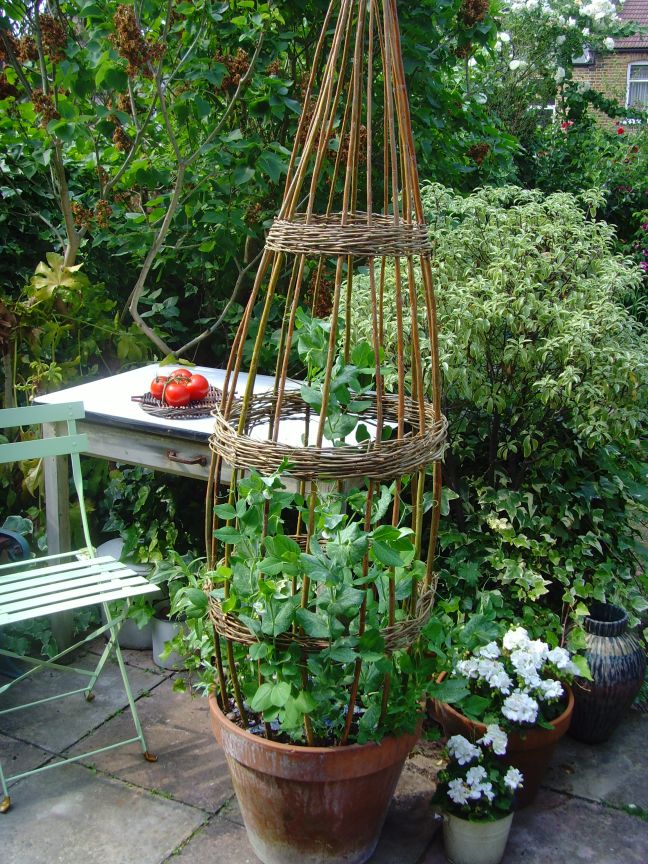
If you want to try growing fresh peas but all you have is a pot on a patio you could make a crafty plant support from willow, hazel or any other long slender rods woven around with something finer and more flexible.  This was a project that didn't make it into the book 'Practical Basketry Techniques' - the co-author didn't like the shape.  I can't imagine why not ...  Anyway, that meant I got to keep this one and the sugar snap peas were a delicious addition to summer salads and stirfries.

We made another version for the kindergarten at a local school, as a plant support for the sweet peas the children had sown in a large wooden planter.  I made a plaited and twined willow dragonfly to hover on top.


Co-author not overly impressed by this one either (made with hazel pea sticks bought from a car-boot sale) but the children loved it.


Later that summer I noticed that the green willow rods we'd used as uprights had taken root.  I've now got a living willow structure - in a pot. Blooming marvellous!  And, nothing wasted, the blue and white willow pattern china I'd used as a decorative mulch provided inspiration for another project.